
On October 7, Anthropic released Claude Haiku 5.5. If you read that and thought, “What is a Haiku, and why are there so many of these?”, this one is for you.
The short version
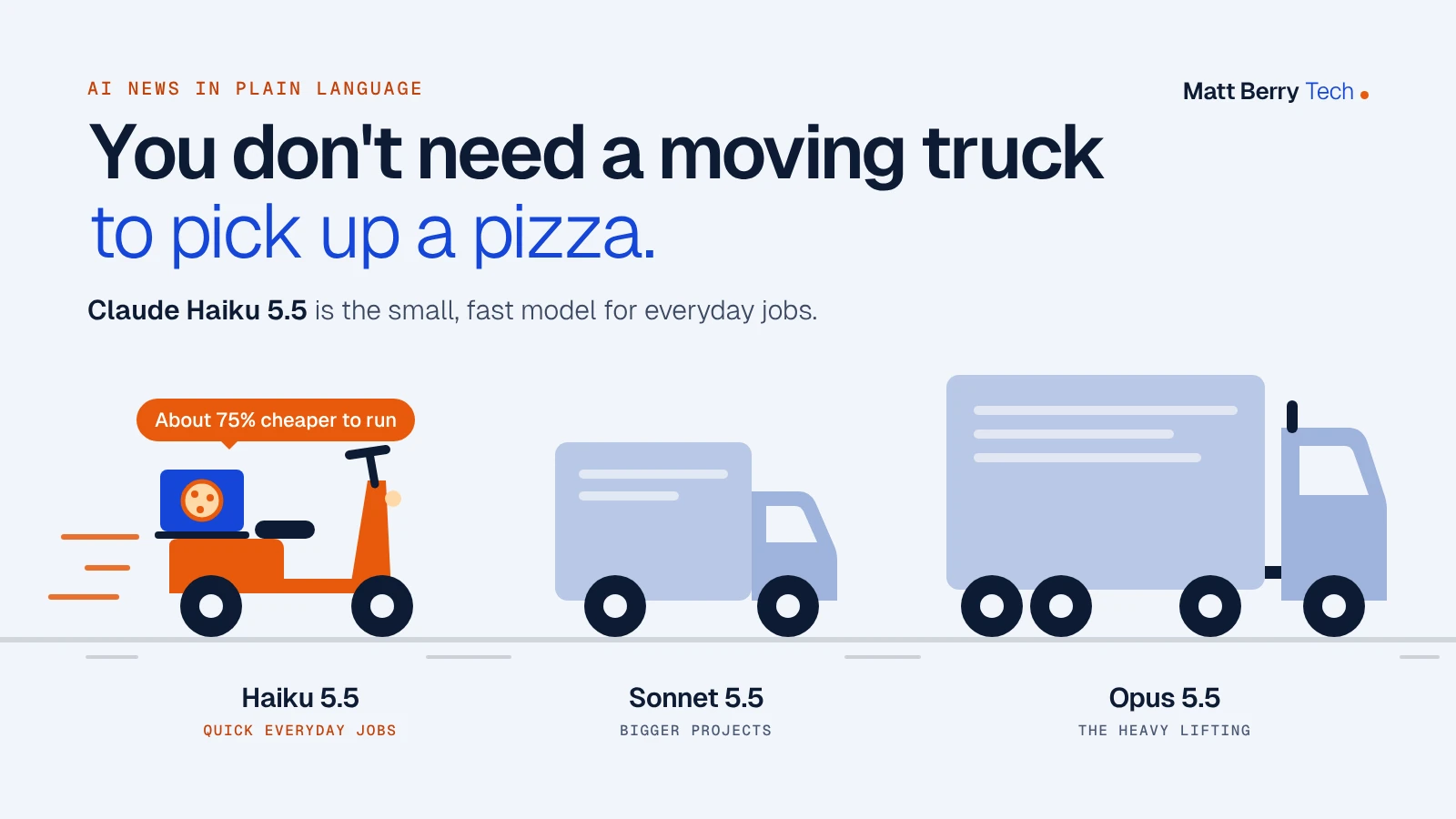
- Claude comes in three sizes: Haiku, Sonnet and Opus. Think small, medium and large.
- Haiku 5.5 is the new small one. It is fast, and Anthropic says it costs about 75% less to run than the last Haiku.
- Pick the right size and you get faster answers and more work done before you hit your plan’s limit.
- If you pay for a Max or Team plan, you now get monthly credits to build your own tools.
What is a “model,” anyway?
A model is the brain behind the chat box. When you type a question into Claude, a model reads it and writes the answer. Anthropic makes that brain in three sizes.
So why not use the biggest one for everything? Same reason you don’t send your most senior person to do data entry. The big model is slower, and it uses up your plan’s limit faster. The small one is quick and cheap, but it will miss things on a hard job.
You don’t rent a moving truck to pick up a pizza. Match the vehicle to the trip.
Haiku 5.5: the quick helper
Use it when the job is simple and there is a lot of it.
- Sum up a long email thread so you know what you missed.
- Pull the dates, names and dollar amounts out of a stack of invoices.
- Sort a shared inbox into billing, support and sales.
- Rename and tag a folder full of files.
- Answer the same customer questions all day in a help chat.
The test: could you hand it to a sharp intern with clear instructions? That is a Haiku job.
Sonnet 5.5: the everyday workhorse
Use it when the job has several steps and the quality matters. This is where most people should spend most of their day.
- Write the first draft of a proposal or a policy from your notes.
- Build a spreadsheet with formulas, clean up messy data and chart it.
- Turn a meeting transcript into action items and a follow-up email.
- Make a slide deck from a report.
- Write a small script, or find and fix a bug in one.
Anthropic says Sonnet 5.5 is the one for clear, everyday tasks and for polished documents, slides and spreadsheets. In one of its own tests, two experts looked at a 10-slide business review Sonnet 5.5 drafted and judged it ready to send as it was.
The test: would you give it to a solid, experienced coworker? That is a Sonnet job.
Opus 5.5: the senior expert
Use it when the job is long, hard, or costly to get wrong.
- Read a 100-page contract and the documents around it, then flag the risks.
- Plan a full SharePoint cleanup: the structure, the permissions and the order to do it in.
- Build a financial model and the presentation that explains it.
- Work alone for hours on one big project, like checking a huge pile of code for problems.
- Poke holes in a big decision before you make it.
Opus 5.5 came out on September 22. Compared with Opus 5, Anthropic says it writes its answers more than 30% faster, costs about 40% less on typical work, and writes in plainer language. So if you remember Opus as the slow, pricey one, take another look.
The test: would you bring in your senior person or a consultant? That is an Opus job.
One morning, three models
Here is how that plays out on a normal Monday.
- Haiku sums up the 60 emails that came in over the weekend.
- Sonnet drafts your reply to the client and updates the project tracker.
- Opus reviews the vendor contract before you sign it.
My rule of thumb: start with Sonnet. Drop down to Haiku when the job is simple and repeats. Step up to Opus when the job is long, hard, or matters a lot.
In the Claude app, you switch sizes with the model menu in the chat box. The free plan includes Haiku 5.5 and Sonnet 5.5. Opus 5.5 needs a paid plan.
What is new in Haiku 5.5
- Price. For normal-sized requests, the list price dropped 90%. The new model counts a bit more text per job, so Anthropic puts the real savings at about 75%.
- Quality. On Anthropic’s own test of everyday office work, Haiku 5.5 scored 1,620. The old Haiku scored 735. That is more than double. Keep in mind these are Anthropic’s numbers.
- Speed. Anthropic calls it its fastest model at normal speed. Box, the file-sharing company, reported about half the wait time compared with the old Haiku.
- Effort. You can now tell Haiku how hard to think. Low effort is cheaper and faster. High effort is smarter.
On a Max or Team plan? You have credits to spend
This part got less attention, and it may matter more. Max and Team plans now come with monthly API credits.
| Plan | Monthly credit |
|---|---|
| Max 5x | $100 |
| Max 20x | $200 |
| Team | $20 per Standard seat and $100 per Premium seat, shared by the team, up to $500 |
The API is how software talks to Claude without the chat window. So these credits are for building your own small tools. A few ideas:
- A script that reads every file in a folder and writes a one-paragraph summary of each.
- A helper that sorts support emails into buckets.
- A small agent that tags documents before you load them into SharePoint.
With Haiku 5.5, my rough math says summing up a 10-page document costs about a tenth of a cent. So $100 goes a long way.
Know the limits:
- The credits do not work in Claude Code. They also do not buy extra usage in the Claude apps.
- They do not roll over. Use them or lose them each month.
- Free, Pro and Enterprise plans do not get them.
- New subscribers wait 7 days before they can claim.
To claim them, go to Settings, then Billing, on claude.ai. Look for the API credits section and link a Claude Console account.
I checked again on October 10. The amounts and the rules still match what Anthropic announced on October 7.
My take
You don’t need to memorize model names. Ask one question before you start: is this an intern job, a coworker job, or an expert job? Then pick the size that fits. And if you pay for Max or Team, claim those credits. They are the easiest excuse you will get to build your first tool past the chat window.
Sources
- Anthropic: Introducing Claude Haiku 5.5 (October 7, 2026)
- Anthropic: Introducing Claude Sonnet 5.5 (September 28, 2026)
- Anthropic: Introducing Claude Opus 5.5 (September 22, 2026)
- Claude release notes
- Claude Platform docs: API credits for Max and Team plans